If your DFW home has a Federal Pacific (FPE) Stab-Lok or a Zinsco electrical panel, it is reasonable to be cautious. Both panel brands have a long, documented history of breakers that can fail to trip during a fault, and the prudent step for a buyer is an independent evaluation by a licensed electrician, with replacement being a common recommendation. A home inspector can flag the panel, but proving a breaker works on overload is outside what a standard Texas inspection does.
What FPE Stab-Lok and Zinsco panels are
Federal Pacific Electric was one of the most common panel makers in the United States from the 1950s into the early 1980s, and its Stab-Lok line shows up in plenty of older North Texas homes. Zinsco (later sold as Sylvania-Zinsco) was another widely installed brand from roughly the same era. Both are load centers: the gray metal box where your main breaker and individual circuit breakers live. They look ordinary, and many have powered homes for decades without an obvious problem. The concern is not how they look. It is whether the breakers reliably do their one critical job, which is to shut off power when a circuit is overloaded or shorted.
The FPE Stab-Lok story and the CPSC investigation
The U.S. Consumer Product Safety Commission (CPSC) investigated FPE Stab-Lok breakers from 1980 to 1983. The probe began in June 1980 after the parent company, Reliance Electric, reported that many breakers did not comply with Underwriters Laboratories (UL) requirements. The CPSC's own testing confirmed that the breakers fail certain UL calibration tests, meaning some may not trip within the required time during an overcurrent event.
Here is the part buyers most often misunderstand. The CPSC closed the investigation in March 1983 without making a safety determination, and it did so primarily for budget reasons. A full assessment was estimated to cost several million dollars against a roughly $34 million budget that year. The agency said the available data did not establish a serious risk, but it specifically reserved the right to reopen the case. A later note clarified that the closure was made without determining whether the breakers were actually safe. In plain terms, the file was not closed because the panels were found safe. It was closed because finishing the study was too expensive.
How Zinsco panels fail
Zinsco panels were never subject to a CPSC recall, but independent testing has raised serious questions. Test work has reported fail-to-trip rates of roughly 29 to 32 percent under UL-489 conditions, meaning a meaningful share of breakers did not trip when they were supposed to. The other documented failure modes involve the aluminum bus bar, where arcing, corrosion, and melted breaker-to-bus connections can occur. The unsettling result is a breaker that looks switched on and appears to be working, yet will not trip on a fault. That is the opposite of what a safety device is supposed to do. For this reason, home inspectors and electricians commonly flag Zinsco panels and recommend evaluation or replacement.
What a TREC inspection actually does with the panel
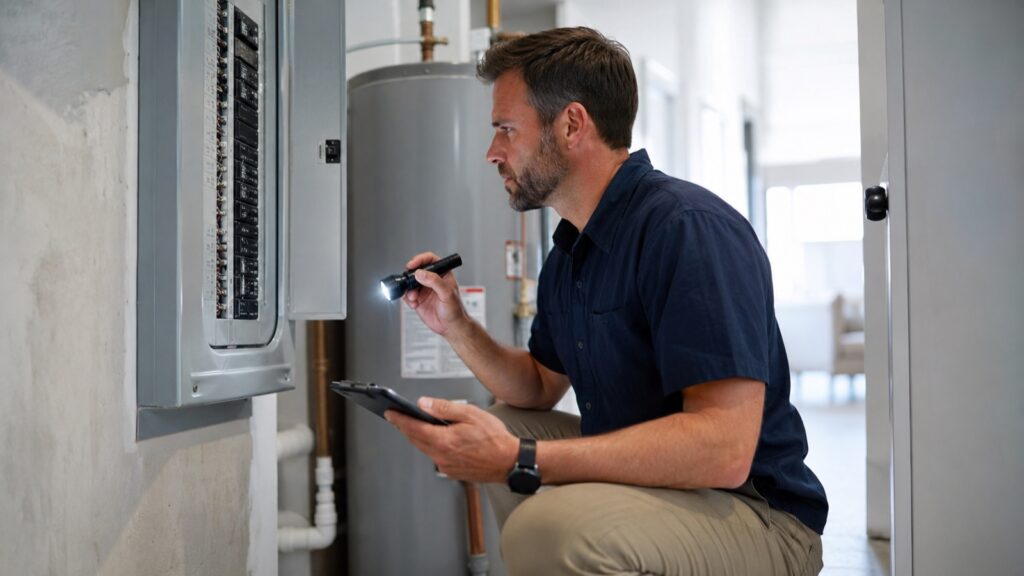
A Texas home inspection follows the TREC Standards of Practice, and the electrical section is 22 TAC 535.229. Under that rule, the inspector reports deficiencies such as a missing dead front or cover, a panel that is not suitable for its location, and incompatibility between breakers and the conductors attached to them. What the rule does NOT require is just as important: the inspector is not required to verify the effectiveness of overcurrent devices or to operate the breakers. So your inspector can identify an FPE or Zinsco panel and note the documented history, but a standard inspection is visual, non-invasive, and point-in-time. It does not test whether each breaker will trip under load, and it does not determine remaining service life. If you want the bigger picture of where the line is drawn, see how the TREC Standards of Practice work and what a home inspection will not catch.
Panels are also where several related findings tend to surface together. While the brand is the headline issue, an inspector may separately note double-tapped breakers or missing GFCI and AFCI protection, both of which are common in older DFW homes regardless of the panel maker.
The prudent step for DFW buyers
If a Federal Pacific Stab-Lok or Zinsco panel turns up during your inspection, treat it as a referral, not a verdict. The reasonable next move is an independent evaluation by a licensed electrician, who can open the panel, assess the bus and breakers, and advise on replacement. Many DFW homeowners choose to replace these panels outright, both for peace of mind and because the cost of a panel swap is modest next to the risk a non-tripping breaker represents. Keep in mind the panel is one of several electrical items worth understanding in older North Texas housing stock, alongside aluminum branch-circuit wiring, which has its own well-documented history.
The smart approach is to get a thorough inspection first, so the panel and any related concerns are documented, then bring in the right specialist where it counts.