Updated October 30, 2026. Nearly a third of the homes listed for sale in Dallas-Fort Worth this year were brand new. New construction is where the incentives are, where the inventory is, and where the most expensive surprises hide. This guide walks through the 2026 DFW new-build market, the parts of the process that trip up buyers, what the city does and does not inspect, which inspections to book and when, how Texas builder warranties really work, and what it all costs. Every figure is sourced and dated, because the market and the law both moved this year.
The 2026 DFW new-build market in numbers
Newly built homes made up 31.0% of all Dallas-Fort Worth-Arlington listings from January through June 2026, and they listed at a 9.8% premium over existing homes, according to Realtor.com's August 2026 ranking of new-construction metros. DFW was the country's largest new-home market in 2024 with 43,830 closings, and it is still a volume market even though 2025 and 2026 cooled.
The cooling is real. Residential Strategies, the Dallas firm whose quarterly counts the industry relies on, reported first-quarter 2026 starts of 11,106 (down 4.3% year over year) and 9,777 closings (down 10.8%), with more than 110,000 vacant developed lots on the ground, a 32-month supply. Principal Ted Wilson put it this way in April: "Many builders used the steadiness of the spring market to work down accumulations of unsold speculative inventory" (WFAA, April 9, 2026). By mid-year, new-construction supply sat at about 4.2 months metro-wide, with Tarrant County tightest at 3.2 months and Rockwall loosest at 5.1, against 5.6 months for resale homes (6th Ave Homes mid-year update).
Prices are flat to slightly down rather than collapsing. MLS data compiled by HomesUSA.com showed 2,122 new-home closings in May 2026 at an average price of $460,012, about $10,000 below May 2025, with new homes sitting an average of 148 days before selling (CultureMap, June 26, 2026). Translation for buyers: builders have finished homes they need to move, and they are paying to move them.
Who is building: D.R. Horton and Lennar are the two giants, together accounting for roughly a third of DFW closings in Builder magazine's 2026 Local Leaders list, followed by Green Brick (parent of Trophy Signature Homes), Meritage, Bloomfield, Highland and Ashton Woods. In permit counts for September 2026, Trophy Signature led the Dallas area with 201 permits, ahead of Lennar at 171 and D.R. Horton at 136 (HBWeekly).
Where the building is happening
The growth is north and east. Census Bureau estimates released in May 2026 made Celina the fastest-growing city in the United States among cities over 20,000 people, up 24.6% in a single year to 64,427 residents. Princeton (up 18.1%), Melissa (14.5%) and Anna (10.2%) took the third, fourth and fifth spots nationally, and Forney grew 8.5%, while the City of Dallas itself lost about 1,800 residents (Community Impact, May 22, 2026). Northlake, Royse City, Midlothian, Haslet, Justin and Aubrey are on the same trajectory a few years behind.
Price points by corridor, from published 2026 community pricing:
- Entry level ($235,000 to $350,000): Princeton from $234,990, Heartland in Forney/Crandall from $242,990, Forney from $275,960, Royse City from the $260s, Anna from $350,990 (Tom's Texas Realty, May 2026).
- Mid-market ($400,000 to $550,000): Midlothian in the high $300s to $500s; Celina's new-construction median about $525,000, which is 22% below its 2023 peak (Grey Square, August 2026).
- Luxury: Prosper's master-planned communities (Windsong Ranch, Star Trail, Light Farms) and Highland Homes' range of roughly $300,000 to $1.8 million across 26 DFW suburbs.
Builder incentives: how to read the offer
By early 2026 about 70% of DFW new-home sales included a rate buydown or other structured incentive (HousingWire, February 2026). The packages are real money. In May 2026 Lennar advertised 3.99% fixed financing (4.799% APR) plus up to $10,000 in closing costs on select inventory homes through Lennar Mortgage; Bloomfield offered $10,000 to $15,000 toward closing costs with an optional 2-1 buydown; a standing-inventory home at Viridian in Arlington stacked a lender-paid buydown, a closing credit and a design-center credit worth about $21,500 combined (DFW builder incentives, May 2026).
Three things to know before you take one:
- The incentive is usually tied to the builder's lender. Federal law (RESPA) stops a builder from requiring you to use its affiliated lender, but it allows the builder to pay you to use it. If you bring your own lender the builder can withdraw the credits; it cannot raise the base price in retaliation. Get the affiliated-business disclosure in writing and compare the real APR, not the headline rate.
- Builders rarely cut the base price. Flex cash, buydowns and upgrades protect the comps in the neighborhood. If you would rather have a lower price than a buydown, ask, but expect the answer to depend on how many finished homes the builder is holding.
- A 2-1 buydown expires. Year one is two points below the note rate, year two is one point below, year three is the full rate. Budget for year three.
The contract is the builder's, not TREC's
Resale buyers in Texas sign a TREC-promulgated contract with a familiar option period and earnest-money rules. Production builders almost never use it. TREC rules let a property owner supply their own contract, and the builder owns the lot, so you will sign the builder's attorney-drafted form. Your agent can fill in blanks but cannot rewrite terms. Typical features, per a September 2026 summary by a DFW brokerage: no option period or a very short one, limits or windows on inspections, earnest money and upgrade deposits that can become non-refundable, broad builder rights to move the completion and closing dates, and dispute terms that favor the builder, often including binding arbitration and a jury waiver.
Earnest money on a new build is commonly 1% to 3% of the price, and deposits on semi-custom homes can be staged at contract, slab and framing. Read the refund language before you wire anything. Ask specifically: on what date does my deposit stop being refundable, and what happens to it if the builder misses the closing date?
The real cost of the lot: MUD, PID, HOA and the year-two tax jump
This is the number most online payment estimators leave out. Many new DFW communities sit inside a Municipal Utility District (MUD), which levies its own property tax to repay the bonds that built the water, sewer and roads, or a Public Improvement District (PID), which does the same through an annual assessment on each lot, typically for 20 to 30 years. Either one lands on top of county, city, school and college taxes.
Concrete examples from published rate sheets:
- Collin County MUD #1, which serves Light Farms in Celina, set its 2025 rate at $0.89 per $100 of value. Trinity Falls in McKinney has two MUDs at $0.9847 and $1.05 per $100 (CCMUD1; McKinney tax analysis). On a $500,000 home that is roughly $4,500 to $5,250 a year before the regular taxes.
- Mustang Lakes in Celina is in a PID instead of a MUD. Its 2023 ad valorem stack was Collin County $0.149343, City of Celina $0.612154, Collin College $0.081220 and Prosper ISD $1.2575, a combined $2.10 per $100, with the PID assessment on top, and HOA dues of $150 to $190 a month depending on lot width. The PID can be prepaid, which a MUD cannot (Mustang Lakes FAQ).
- Celina homes in standard subdivisions pay an effective rate of roughly 1.86% to 1.94%; in MUD communities it is 2.10% to 2.35%, a difference of $1,260 to $2,573 a year on a $525,000 home (Grey Square).
- Windsong Ranch in Prosper has no MUD or PID; its total rate is about 1.98%. That is a selling point worth asking every builder to match or explain.
Then there is the second-year surprise. Texas appraisal districts value property as of January 1. If your home was not finished on January 1, you are taxed on the land (plus whatever was built) for that first year. The next January it is valued as a finished home, and the bill can jump 40% to 60%. Lenders then recalculate escrow, and a monthly shortage of several hundred dollars is common (LRG Realty, September 2026). The 10% homestead cap does not protect you from that jump, because the cap only starts the year after you first qualify and new improvements are added on top of it. Two pieces of good news: Texas voters approved Proposition 13 in November 2025, raising the school-district homestead exemption to $140,000 ($200,000 if you are 65 or older or disabled), and if you buy in 2026 you can file your homestead exemption by April 30, 2027 as long as the home is your primary residence on January 1.
Before you sign, get three numbers in writing from the builder: the MUD rate or PID assessment, how many years remain on it, and what your first full-year tax bill will be on the finished value.
What the city inspects, and what it does not
Every new home in an incorporated DFW city goes through a sequence of municipal inspections. Fort Worth's published list is a good example: stakeout, plumbing underground and sewer yard line, electrical underground and slab grounding, a foundation inspection after the reinforcing steel is placed and before concrete, sheathing, mechanical rough, electrical rough, plumbing top-out and a gas pressure test, frame (only after the three rough-ins pass), insulation (the builder must hand the inspector blower-door and duct-leakage reports), and final (City of Fort Worth, What Inspections Are Required). Fort Worth builds to the 2021 International Residential Code and the 2015 energy code with local amendments; Dallas adopted the 2021 energy code in 2023.
So the city does check the slab steel and the framing. What it checks is minimum code compliance, with a schedule that allows a short visit per stop and no written report to you. The city is not grading workmanship, verifying manufacturer installation instructions, or checking whether the duct joints were sealed after the inspector left. A professional pre-drywall inspection of the same house takes two to three hours and produces a photo report you can hand to the construction manager.
In unincorporated areas of participating counties, Texas Local Government Code 233.153 and 233.154 require the IRC to be followed and a minimum of three inspections (foundation, framing and mechanical, completion), but enforcement is thinner than inside a city.
The builder's third-party inspector works for the builder
Many DFW builders tell buyers "we already have a third-party inspection." That is true, and it is worth understanding what it means. Texas does not require third-party inspections at all; builders hire engineering and quality-control firms voluntarily, often for foundation design, framing checks and the energy testing (blower door, duct blaster) that the code requires. Those firms are paid by the builder, scoped by the builder, and their reports go to the builder. One longtime North Texas inspection company describes it plainly: the builder's third party "is working for them with express boundaries concerning what they can and cannot make comment about and you do not get a written report" (Buyer's Inspection Service).
Texas also does not license home builders or general contractors at the state level. The state agency that once handled new-home disputes, the Texas Residential Construction Commission, was allowed to expire on September 1, 2009 after the Sunset Commission found it "was never meant to provide meaningful oversight," and a survey found 69% of homeowners said it never helped them (Sunset Advisory Commission, 2009; KUT). Nothing replaced it. The only inspector in the process who works for you is the one you hire.
A note on what "TREC-licensed" covers. TREC's Standards of Practice (22 TAC 535.227 through 535.233) define a home inspection as "a limited visual survey and basic performance evaluation" of a home that is "substantially completed," and they say the inspector is not required to determine "compliance with any code" (TREC Standards of Practice). Pre-pour and pre-drywall inspections go beyond that minimum, so ask any inspector you consider how many phase inspections they do and what their pre-drywall report looks like. A licence is the floor, not the ceiling.
The three phases plus the 11-month: what each catches
Phase 1: pre-pour foundation
Booked before the concrete truck arrives. Most of North Texas sits on Blackland Prairie clay that swells when wet and shrinks when dry, and that shrink-swell cycle is the leading cause of slab damage in Texas homes. The answer in DFW is almost always a post-tension slab: steel cables in plastic sheathing are tensioned after the concrete cures, putting the slab in compression so it rides the soil as a unit. A pre-pour inspection checks that the cables and rebar are placed and supported per the engineer's plan, that the sheathing is intact (a nicked sheath lets the cable corrode, and a corroded or cut tendon can later blow a cone of concrete out of the slab edge), that the vapor barrier is in place and the forms, plumbing and electrical penetrations are where the drawings say. Post-tension makes a slab stronger; it does not reduce how much the clay underneath moves, which is why grading and drainage show up again at every later phase. This is the only phase that can never be reopened. Our guide to post-tension slabs in DFW goes deeper.
Phase 2: pre-drywall
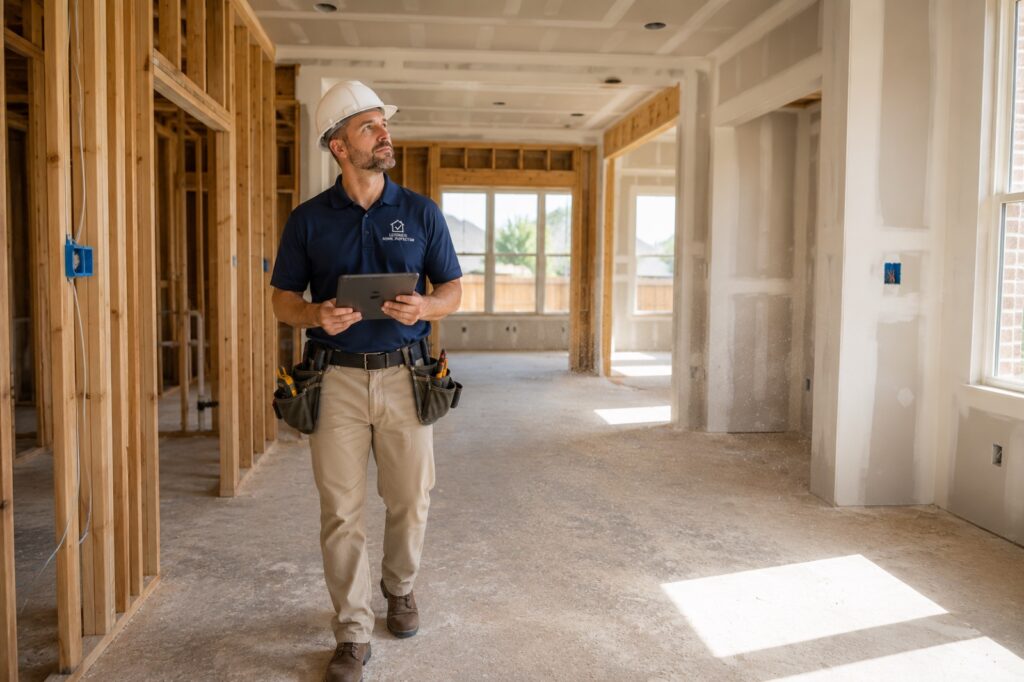
Booked after the city passes the electrical, plumbing and mechanical rough-ins and the frame inspection, and before insulation goes in. On most DFW builds that window opens roughly 60 to 90 days after start and lasts only two to five days, so tell the construction manager at contract that you want 48 hours' written notice. This is the phase that pays for itself most often, because everything is still visible: framing and structural connections, window and door flashing, roof decking and underlayment, electrical rough-in, plumbing supply and drain slope, HVAC duct joints and returns, fire blocking, and the penetrations through the slab. A problem found now is a quick fix; the same problem found after closing means opening finished walls. Buffalo Property Inspections' pre-drywall inspection page lists exactly what the visit covers, and our article on what a pre-drywall inspection is explains how to schedule it.
Phase 3: final
A full TREC-standard inspection of the finished home, booked a few days to a week before closing and, ideally, two days before the builder's own blue-tape walkthrough so you can hand the report to the builder at the walk. The blue-tape walk is a cosmetic punch list: paint touch-ups, countertop scratches, cabinet adjustments. It does not run the HVAC under load, open the electrical panel, walk the roof, check attic ventilation or test the plumbing. The final inspection does. Common findings in brand-new DFW homes include missing GFCI protection, double-tapped breakers, disconnected or leaking ducts, drain lines without support, missing water-heater expansion tanks, grading that slopes toward the foundation, and brick weep holes that are blocked or absent (the code calls for weep holes at least 3/16 inch wide, no more than 33 inches apart, directly above the flashing). See our list of 10 common defects in brand-new DFW homes.
The 11-month warranty inspection
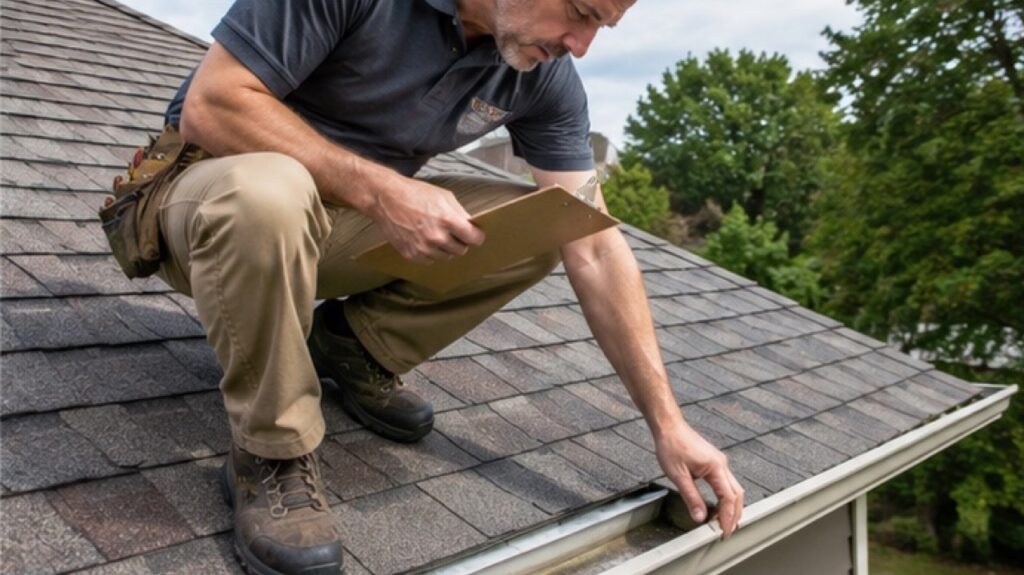
Your builder's one-year workmanship warranty expires on the first anniversary of closing, and claims must be in writing before then. An inspection at month 10 or 11 finds what a year of Texas weather did: foundation movement since closing, drywall cracks at window and door corners, nail pops, roof and flashing issues, HVAC and plumbing performance after a full season, and settlement in the grading. It gives you a written list to submit while the builder still has to fix it for free. Buffalo Property Inspections explains the timing on its 11-month inspection page: schedule around month 10 or 11 so there is time to submit the report and get repairs on the calendar before coverage ends.
Your warranty: 1-2-10 is becoming 1-2-6
Texas has no state-mandated new-home warranty. What you get is the builder's written limited warranty, usually in the 1-2-10 shape that was copied from the old statutory warranty: one year on workmanship and materials, two years on the plumbing, electrical and HVAC delivery systems, ten years on major structural components. Many builders back the structural piece through a third-party administrator such as 2-10 Home Buyers Warranty, StrucSure or Bonded Builders Warranty Group. 2-10 notes that Texas foundations fail at a rate it puts at ten times the national average and that its Texas structural coverage has no soil exclusions, which matters on clay (2-10 HBW). Ask which company backs yours and read the actual document, not the brochure.
The 2026 change: House Bill 2024, effective June 9, 2023, lets a builder who provides a written warranty of at least one year workmanship, two years systems and six years structural shorten the statute of repose, the outside deadline for construction-defect claims, from ten years to six. Builders are adopting it. Highland Homes, for example, moved to six-year structural coverage for contracts dated January 1, 2026 or later, while earlier contracts keep ten (Highland Homes warranty summary, September 2026). Under the six-year track, presenting a written claim to the builder before the deadline extends your time to file by one year, so document in writing, always.
How to use the warranty: submit every request in writing through the builder's or administrator's portal with photos and dates, keep every reply, and get the workmanship items in before the one-year anniversary. Most builders schedule a 30-day and an 11-month visit; the 11-month inspection report is what you bring to the second one.
If something goes wrong: the RCLA process
Construction-defect disputes with a builder in Texas run through the Residential Construction Liability Act, Chapter 27 of the Property Code. Before you can sue or start arbitration you must send the builder written notice by certified mail, return receipt requested, at least 60 days ahead, describing the defects in reasonable detail. The builder then has 35 days to request an inspection and 45 days to make a written settlement offer; you have 25 days to accept or reject (silence counts as rejection); the builder may make one supplemental offer within 10 days; and accepted repairs must be finished within 45 days (Texas Property Code Chapter 27; summary by Matthiesen, Wickert & Lehrer). Rejecting a reasonable offer can limit what you recover later, so get advice from a construction attorney before you reject anything. The paper trail you built with phase inspection reports and written warranty requests is what makes this process work in your favor.
Questions to ask before you sign
- Who backs the structural warranty, and is it ten-year or six-year under HB 2024? May I see the full warranty document now?
- Does the contract allow my own inspector at pre-pour, pre-drywall and final? What notice, licence proof or insurance certificate do you require, and who do I coordinate with?
- Is there an option period? On what date does my earnest money become non-refundable, and what happens if you miss the closing date?
- Does the contract require arbitration or waive a jury trial?
- Is this lot in a MUD or a PID? What is the rate or assessment, how many years remain, and can it be prepaid? What are the HOA dues and what do they cover?
- What exactly are the incentives if I use your lender, and which of them disappear if I use my own?
- What will my first full-year tax bill be on the finished value, and what will escrow look like after the first January reassessment?
- Which third-party quality or energy firm do you use, and will I receive their reports and the blower-door and duct-leakage results?
- Can I get references from buyers who closed in this community in the last six months?
- What are the restrictive covenants, and what is planned for the land around the community in the next five years?
Timeline: when to book each inspection
- At contract: tell the construction manager in writing that you will have independent inspections at pre-pour, pre-drywall and final, and ask how they want to be notified. Book the pre-pour now; the pour date moves with the weather.
- Weeks 4 to 10: permitting. Months 2 to 3: foundation. Your pre-pour inspection happens after the steel is placed and before concrete, the same stage as the city's foundation inspection.
- Months 3 to 5: framing and rough-ins. The pre-drywall window opens after the city frame inspection passes and closes when insulation starts, often within two to five days. Give your inspector the construction manager's number so they can coordinate directly.
- Months 5 to 9: mechanical, interior, exterior. Lock your rate 30 to 60 days before the expected close.
- One to two weeks before closing: final inspection, then the builder's blue-tape walk with the report in hand. Expect a production home to take six to nine months, and keep a 60 to 90 day buffer on your lease or sale.
- Months 10 to 11 after closing: 11-month inspection, written claims submitted before the anniversary.
What it costs in DFW
Published 2026 prices from DFW inspection companies cluster in these ranges: single phase inspections (pre-pour or pre-drywall) about $300 to $500; a final new-build inspection $400 to $600 depending on size; an 11-month inspection $300 to $600; and many companies price by square footage, with homes over 3,000 square feet costing more. Several firms quote phase work only on request.
Buffalo Property Inspections, which publishes its prices, starts a single New Build Inspection at $399 for homes up to 1,500 square feet ($449 at 2,200 and $499 at 2,800), and bundles the phases: Pre-Drywall Bundle (pre-drywall plus final) from $623, New Build Bundle (final plus 11-month) from $723, Pre-Pour Bundle (pre-pour, pre-drywall and final) from $908, Deluxe New Build Bundle (pre-drywall, final and 11-month) from $1,022, and the Full Phase Bundle covering all four visits from $1,307, with larger homes priced by size (bundle pricing). Against a $460,000 average new-home price, the full four-visit package is under 0.3% of the purchase.
The short version
New construction in DFW in 2026 is a buyer's market with real incentives, but the structure of the deal favors the builder: their contract, their lender, their third-party inspector, a warranty that is quietly getting shorter, and a tax bill that jumps in year two. The counterweights are all in your hands. Read the MUD or PID numbers before you fall in love with the kitchen. Put your right to inspect in writing at contract. Book the pre-pour, pre-drywall and final inspections, and the 11-month before the warranty runs out. Keep everything in writing. Buyers who do those five things close on the house they think they are buying.
Related reading: do I need an inspection on a brand-new home?, should I trust the builder to inspect their own home?, the top mistakes new-construction buyers make, foundation movement in North Texas, and drainage and grading on North Texas clay.