In North Texas, most central air conditioners last about 12 to 15 years, and gas furnaces tend to run 15 to 20 years. There is no hard cutoff where a system is automatically "too old," but once an AC passes the 12-to-15-year mark, it is fair to start planning for replacement, especially here where brutal summer heat pushes equipment harder than in cooler climates.
Why Texas Heat Shortens AC Life
Air conditioners are rated for a typical lifespan in moderate conditions, but Dallas-Fort Worth summers are anything but moderate. When it is 105 degrees outside for days on end, your AC runs nearly nonstop to keep the house comfortable. All those extra run hours add up. Compressors cycle longer, fan motors spin more, and refrigerant components work under higher pressure. The result is that an AC that might reach 18 years in a mild climate often wears out closer to 12 to 15 here.
Heat also stresses the outdoor condenser unit directly. Sun exposure, dust, and the fine grit that blows around during dry spells all take a toll. Regular cleaning and filter changes help, which is one reason we cover cooling-season prep in our guide to seasonal home maintenance for North Texas. A well-maintained system tends to reach the upper end of its expected range; a neglected one fails sooner.
How to Read the Age From the Data Plate
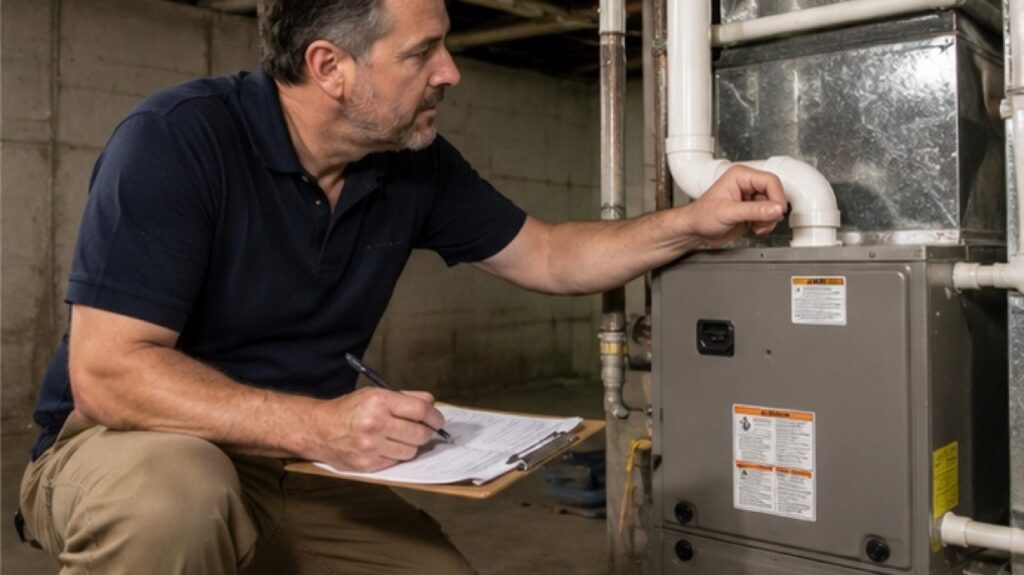
You do not have to guess how old your equipment is. Both the outdoor condenser and the furnace carry a metal data plate, usually with a model number and a serial number. The manufacture date is often encoded in that serial number. Some brands print the date plainly, while others bury it in the first few digits or letters of the serial. An inspector or HVAC tech can usually decode it, and many manufacturer lookup tools are available online.
Keep in mind that the condenser and the indoor furnace or air handler may be different ages. It is common in DFW homes for one part to have been replaced while the other stayed original. When you read your inspection findings, note the age of each component separately. Our walkthrough on how to read your inspection report can help you make sense of how these details are presented.
R-22 Versus R-410A: Why It Matters
The type of refrigerant your AC uses is a strong clue to its age and its future cost. Older systems, generally those installed before about 2010, often use R-22 refrigerant. R-22 has been phased out of production in the United States because of its effect on the ozone layer. It is no longer manufactured or imported, so any remaining supply is recycled or stockpiled, which makes it expensive and increasingly hard to find.
Newer systems use R-410A, which is still widely available. The practical takeaway is this: if you have an older R-22 unit and it develops a refrigerant leak, recharging it can be costly, and you cannot simply swap in a different refrigerant without changing major components. A repair that would be minor on a newer system can tip the scales toward full replacement on an older R-22 unit. So an aging AC is not just about wear; it is also about whether parts and refrigerant are still practical to source.
What a Home Inspector Tests and Where the Limits Are
During a standard Texas home inspection, the inspector evaluates the HVAC system visually and operationally, in line with the TREC Standards of Practice. That means turning the system on using normal controls and checking that it runs. For cooling, inspectors commonly measure the temperature difference between the air going into the return and the air coming out of the supply registers, often called the split or temperature differential. A reasonable differential suggests the system is cooling as expected; a poor one points to a possible problem worth a closer look.
The inspector also looks at visible components: the condenser, accessible ductwork, the condensate drain, visible refrigerant lines, and the furnace as far as it can be safely observed. HVAC is one of the bigger-ticket items covered, and you can see the full picture in what a home inspection covers in DFW.
There are real limits, though, and an honest inspector will be clear about them. A standard inspection is visual, non-invasive, and a snapshot of the system on the day it is tested. The inspector reports the system's age and any visible conditions, but does not open the sealed refrigerant circuit, does not measure refrigerant charge with gauges, and cannot determine how much usable life the equipment has left. A 16-year-old unit might run for several more years, or it might fail next summer. The inspection tells you what is observable now, not what will happen later.
So, When Is It Too Old?
Use age as a planning signal, not a verdict. If your AC is past 12 to 15 years, or your furnace is past 15 to 20, it is wise to budget for replacement even if the system still works. Pair that age with the refrigerant type, the maintenance history, and the inspector's observed condition to get the full picture. An old but well-kept R-410A system is in a much better spot than a neglected R-22 unit of the same age.
You will get the age, the observed condition, and an honest account of what the inspection can and cannot tell you, so you can plan your next move with confidence.